Tuesday, February 23, 2010

Worms Go To School

                                                                      
  Worms Go To School! 

Worms eat our food scraps and leave compost in the soil.  Compost feeds the plants and the plants feed us.  This winter the pre-schoolers at Anishinabe Academy in South Minneapolis are learning how this simple and respectful cycle works by growing worms fed with the kids own food scraps right in their classroom.  While children at Anishinabe are learning in class about worms, soil, seeds, plants, food, and health, a team of energized, organized grown-ups from the school and community are learning how to grow opportunities for the kids to get their hands dirty in the garden. 
I’m not sure if worms can smile, but I smile when I think about kids learning how to empower their health, respect their environment, and sustain their culture.  The 7th Generation Garden Design Circle has taken root at Anishinabe in order to nurture these wonderful ideas and grow them into a verdant garden of opportunities for the children, families, and staff of the school.  Through the development of curriculum based on native culture, nutrition, Earth-friendly gardening practices, restorative justice, and compost heaps of fun, the 7th Generation gardeners are growing awareness, community, and happy kids!
This volume of The Seed is dedicated to the Ojibwe and Dakota High-5 language classes at Anishinabe Academy.  Thanks to the super smart kids and teachers in these classes, worms are doing their wiggly work to slime through the grime and turn garbage into garden gold!  May the seeds they plant grow into a community of opportunity!

CLICK HERE to read The Seed #35, Worms Go To School!

Thursday, January 21, 2010

The Seed Volume 34, Compost Growing Community


   In recent month’s we at Giving Tree Gardens have witnessed and helped facilitate an environmentally sound change in the way a few Minneapolis organizations view the waste they create.  Almost every group or organization of folks has the potential to  begin producing compost for use in urban farms as well as home and community gardens.  Wherever people gather, they eat, and wherever people eat, they produce food scraps.    While some organizations can put their food scraps to use on-site in their own compost bins, others turn their compostables over to local urban farms that are actively seeking food scrap donations for mass compost production. 

   This month’s volume of The Seed is dedicated to giving organizations on the verge of change a how-to guide for dealing with their food waste in an environmentally wise way.   Read below for a list of green resources for employees and volunteers looking to guide their organization toward a healthier tomorrow, as well as step-by-step guide to building a low-budget, community enhancing compost bin.

CLICK HERE to read The Seed #34, Compost Growing Community!

Wednesday, January 6, 2010

Giving Tree Gardens Expands Archives!


Giving Tree Gardens would like to welcome in the new year with a gift to all the gardening world!
Our newsletter, "The Seed" is nearly 3 years old, and with 33 informative issues currently in our archives, we thought it high time to make the archives a little more accessible. Visit our
new expanded archives
to learn everything you want to know about organic gardening and Earth-friendly landscaping!


CLICK BELOW TO SEE THE NEW EXPANDED ARCHIVES!


CLICK HERE TO VIEW THE SEED ARCHIVES

Monday, December 21, 2009

The Seed Volume 33, Garden Tool Review!


Toolin' Around

"Give a boy an apple and he will eat for a few minutes, teach him to garden and he will eat well his whole life! When we teach our kids about organic gardening we give them the tools to build a healthy future!"


While it’s true that a determined gardener can do more with a rusty shovel then a lazy gardener can with a whole shed full of tools, it’s also true that when given the right tools for the job, determined gardeners are unstoppable. Coming across a tool that makes my work easier is like meeting a new friend, I’ll often find myself wondering how I ever got along without them.
The blanket of snow adorning our fair cities gives northern gardeners time for reflection on the seasons’ success and lessons so that we may continue profusely sharing our profound passions. In this spirit of sharing, Giving Tree Gardens would like to present this years cream of the crop from the world of garden tools. This month’s volume of The Seed celebrates with all our gardening friends a few of the handy tools that helped us achieve this season's garden accomplishments. 

Talkin' Tools! A Few of my Favorite Things...
Having the right tools for the job makes life so much easier!

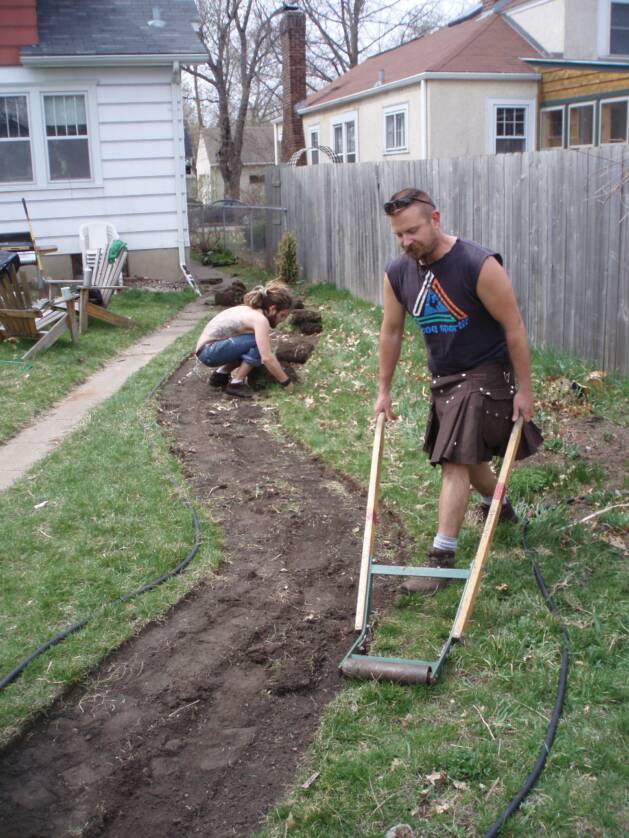
The Sod Cutter
 
  Never do I feel like more of a superhero as when I brandish my freshly sharpened sod cutter and peel away at sheet after sheet of useless boring sod grass.  I’m fond of telling folks new to using a sod cutter that this is one implement that turns a man into a mule.  Though gasoline powered versions of this fantastic tool are available for rent or purchase locally, there’s nothing quite as satisfying to a gardener as using one’s own power and strength to cause a healthy landscape makeover to occur.  Reddy Rents on Hiawatha is the spot to find both the human and petroleum powered versions of this fine tool. 

Utilikilt!
"The Utilikilt offers a man freedom, comfort, and rugged durability, not to mention a nice fresh breeze through the hot summer work days.  Hard working guys need to treat their tools with care, the Utilikilt is here to help!" 

    Freedom grows in this gardener’s gardens.  Freedom to eat healthy food, freedom to enjoy nature, and freedom to know that I’m treating the environment with respect and love are just a few of my gardens gifts.  With all this freedom flowing from the garden growth, it’s only appropriate that the gardener himself feels as free. 

  Utilikilts is a Seattle based company that brings freedom to men everywhere.  As soon as I donned my first Utilikilt, I knew I was in love.  I’ve never had an easier time jumping in and out of my truck bed, stretching through the garden for those hard to reach weeds, or attracting attention from passers by.  Folks seem either impressed or surprised to see a hairy burly man, proudly wearing a tough looking skirt through the city.  I couldn’t have guessed at the marketing power of the kilt, but after handing out hundreds of business cards to folks who approach me because of the kilts, I’ve become a firm believer. 


The Weed Wrench

   Perhaps the greatest time saving tool I’ve ever found, The Weed Wrench is less a miracle of modern engineering then an ancient, time tested design improved through the strength of hardened steel. 

  A little leverage goes a long way could be the work song chorus of anyone bearing this tool.  Simply clamp the vice like metal jaws around the base of any weed tree you’d like to remove then lean back and let the 6 foot metal pry bar do the hard work.  I remove a lot of buckthorn from Twin Cities properties, and this tool cuts a 2 hour tree removal down to 5 minutes.  The Weed Wrench is worth it’s weight in gold, and from it’s price you might think that it’s made of gold.  If however you’ve got a whole mess of buckthorn trees in the back 40, then this tool will quickly pay for itself in saved time and back pain.  Check with Reddy Rents in the early winter months to see if they’ve got any slightly used Weed Wrenches for sale.  You’ll save a good chunk of change and the Weed Wrench is so strongly made that even well used tools will still have decades of life in them.

I like this tool so much, I made an instructional video!


Felco #2 Pruning Shears

I never go anywhere without my Felco # 2 Pruning Shear.  These are the handiest and sturdiest cutting tool I've ever owned, this garden helper will hopefully become a family heirloom.

Let me help you cut through the crap.  Using a poorly working pruning sheer can wreak havoc on your woody garden plants, and frustrate the heck out of any busy spring gardener.  The best pruning tools on the market are made by Felco.  Their designs have blades that can be sharpened and replaced, steel springs that can be easily removed for cleaning, and they have slickest by-pass anvil design available.  Of all the Felco products, the Felco #2 is my faithful companion.  Every time I slide this tool out of it’s belt bound leather holster I trust that the branches I remove will be cut cleanly and without crushing.  This is a great tool that every gardener would love to find in their holiday stocking.  Felco tools can be found at any reputable local retailer of garden tools and supplies.

The Toughest Wheelbarrow in Town!

At Giving Tree Gardens we need the toughest wheel barrows around, and there's none we've seen tougher then the Brentwood Industries Pro-Boss.  This barrow is a real mover and shaker with it's structural steel chassis and hardwood handles.

In the battle for the better barrow my 6 cubic foot Brentwood Industries Pro-Boss model is by far the best of the bunch.  Before I met this beastly bucket on wheels, I was sure that I’d be buying a new wheelbarrow annually because of the abuse that I bestow upon them.  This well designed wheelbarrow has thick steel legs and a larger then average hard plastic basin that won’t rust out.  I fill my wheelbarrows with the roughest stuff, broken concrete, bricks, rocks, and sand, and I barely notice the wear and tear on this workhorse.  Available locally at Klier’s Nursery, I’d recommend anyone considering a new wheelbarrow stop by to give this one a test drive. 

A gardener’s work is truly never done, so we might as well equip ourselves with the tools that make our work go as smoothly as possible.  Mother Earth Gardens, Reddy Rents, and Klier’s Nursery are a few local stores that work hard to offer us the equipment that can make our green-guided lives a little easier. 
  Any tool is only as useful as the hand that holds it, and our towns are chock full of hard working hands.  If you’ve got a gardener in your life, consider giving one of these fine tools as a gift this year.  After all, outfitting a gardener with good tools will likely pay off with healthy, beautiful rewards for years to come. 

These young fellas hold the tools that will be used to build the future.  With the huge environmental  challenges ahead we need to make sure and leave our kids with the best tools possible.  Organic gardening knowledge is absolutely one of the strongest tools that we have to gift to our children.


“Anything you can do needs to be done, so pick up the tool of your choice and get started”

  "When the only tool you have is a hammer,
you tend to see every problem as a nail."


  "A worker may be the hammer's master, but the hammer still prevails. A tool knows exactly how it is meant to be handled, while the user of the tool can only have an approximate idea."
Photos by Russ Henry  ©2009 ,Text by Russ Henry ©2009 by Giving Tree Gardens, all rights reserved.
  Giving Tree Garden's privacy policy

Thursday, November 19, 2009

Compost, It's Hot!


These days it seems folks all around me are taking bold strides to “green up” their everyday lives.  Whether we’re motivated to reclaim our health from the abominable agriculture and healthcare industries, or take back our wealth from the robber barons of the big energy companies, all of us are awakening to the idea that it’s time we followed that sage bumper sticker advice and remember how to live simply so that we may simply live. 

Composting is one of the simplest things that I’ve ever learned.  As a designer of Earth friendly landscapes and organic gardens, part of my job is to help folks implement changes right outside their doors that positively impact the entire global ecosystem.  I routinely testify that there is no greater teacher of natural methods then nature itself.  


So what does nature tell us about compost? 
 
In nature there is no waste.  Any creature lucky enough to emerge from the muck is quickly turned back into muck upon death, at which point another creature feeds on the muck created by the first creature.  Life, death, rebirth, I’m guessing you’ve all heard about this process.  When we compost we pay direct homage to this ancient cycle, and our gardens display the rewards of this environmentally respectful approach.  What I’m getting at here is that nature shows us that compost grows great plants.  Compost has always been the only sustainable means of creating fertility in soil.

Okay so enough about why we should compost, let’s get down to the nitty-gritty.
First of all, I’m through with black plastic compost bins.  Frankly, I hate them.  Ineffective, ugly, and misleading to folks, these bins are ridiculous.  We already know that the act of composting at home is a way of copying nature.  Ask yourself, when was the last time you found a black plastic compost bin on the prairie, or in the woods, or wetlands?  Compost happens in nature completely unaided and unhindered by plastic bins.  Instead all the parts of the trees, and plants grow up and then periodically or seasonally die off to fall loosely across an open area where the rain soaks the leaves, and the wind and animals stir the whole thing up.  After a good sit on the floor of the forest or prairie, a dead leaf or fallen apple becomes soil.  At home we copy this process, in an open air compost bin or compost pile we mix together our kitchen waste such as fruits and vegetables, coffee, egg shells, grains, and bread, with our yard waste such as leaves and grass cuttings.
 
This edition of The Seed is dedicated to the hundreds of folks who've asked me how they can make a functional, affordable, and aesthetically pleasing compost system at home.  Giving Tree Gardens Russ Henry is proud to have partnered with another green thinker, Margaret Wilke to bring you two great gardeners thoughts on growing garden gold from garbage!

 Garden How To : home composting made easy
 

When attempting to adapt open air composting to the urban environment a little experienced advice can be handy.  I always describe the best urban composting system as the 4-Bin system that I learned from my friend Margaret Wilke.  Simply make 4 bins that are at least 3 feet wide and 3 feet deep each.  The bins should be made out of whatever re-usable construction materials you have around.  I love to use chicken wire and stakes because they’re cheap and breathable.  Make sure the sides of your bins allow for a lot of air flow, so if you make your bins out of wood leave a few inches of space between each board.  Situate your bins in a location that is easily accessible so you don’t feel like you’re going for a hike each time you bring a bucket of kitchen scraps out.

  If you are worried about ill-tempered neighbors or city inspectors, you could always plant raspberry bushes along the sides of your bins.  That way the bins will be disguised and you’ll have a peace offering to share with any disgruntled passers by.  Using your 4-bin system should look a little something like this:

Bin 1:  This is a storage space for yard waste.

Bin 2:  Whenever I’ve collected enough food waste in my kitchen scrap bucket I empty the bucket into Bin 2 and then I layer on a healthy dose of yard waste from Bin 1.

Bin 3:  After Bin 2 is full, I move all of its contents into Bin 3.

Bin 4:  After Bin 3 is full, I move all of its contents into Bin 4.

By the time you’ve layered and then moved your compostables from bin to bin a few times you’ve got yourself some real garden gold.  Feed your new plantings plenty of this fine homemade magic and watch them grow healthy and bountiful.  Give the entire garden a 2-inch layer of compost each spring in order to ensure a full season of growth.

Composting is not a science; it is an easy craft that anyone can master.  The only other advice I can think of on the matter is to be flexible, adjust the materials and size of the bins to suit your needs.  Don’t get hung up about your ratio of kitchen waste to yard waste, your yard’s a little piece of nature and there’s supposed to be way more leaves and grass cuttings then there are fruits and vegetables.  Feel free to put some soil or already composted materials in with your bins, this can help speed up your composting process.  Composting is easy, so don't let your scraps go to waste anymore! 

Margaret talks compost

Margaret stands beside the compost system that she's been faithfully using for more then 20 years in the picture below.  Composting is one of Margaret's passions, and her wisdom rubs off on anyone who visits her gardens!

Composting is one of my passions.  I think it is because it is a kind of alchemy.  You can turn things that people normally throw away into GOLD!  Well, not real gold, but something as valuable as gold to anyone who gardens.  You would have to pay a lot of money to get the kind of enrichment for your soil that organic compost gives you, and my bet is it wouldn’t be as good, either for the garden or for the environment.

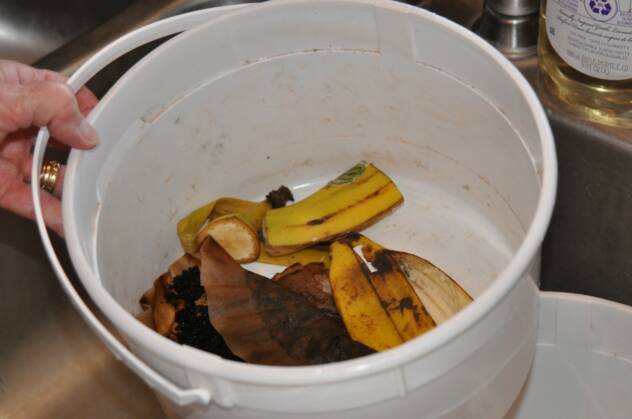
It all starts in the kitchen.  We keep an old ice cream bucket with a lid handy in the kitchen sink. Everything that is plant based, that normally would go into the trash, winds up in the bucket instead.  Even with just two of us these days, my husband and I, we often have a bucket or more of material to take out to the compost heap every day, especially in the summer.  It makes us very aware of how much we are dependent on the products from the earth for our health and well being.  Food comes from somewhere, and it’s not the grocery store!  And plant material needs to go back into the garden to complete the God-given natural cycle that sustains life.


We compost as long as we can into the fall, and begin again in the spring as soon as there are any days above freezing. Actually, I should rephrase that. I compost as long as I can into the fall, and begin again in the spring as soon as there are any days above freezing. My husband just puts up with me.

Here’s what goes into the bucket from the kitchen:

All vegetable and fruit trimmings, skins, seeds, stems, leaves, etc.
Coffee grounds (very key because they have nitrogen that helps the compost “cook”)
Tea bags
Egg shells
Left over / day old / moldy bread products (no butter please!)


My family knows that Mom will have a fit if she finds a banana peel in the kitchen trashcan. Roses love bananas.

We add this kitchen mix to the compost pile daily and ALWAYS cover it with dry leaves or fresh green material such as garden trimmings and grass clippings (IF they are chemical free). It is amazing how fast those banana peels, potato skins, and broccoli stems break down and become completely unrecognizable! Eggshells take longer, so I generally try to break them up before putting them in the pile. If there hasn’t been rain for a while I occasionally water down the piles, but not very often. Once in a while I shovel some partially finished compost and/or garden soil over the top of everything to give it the microbes it needs to break down. That also ensures there are no odors from the pile for neighbors to complain about. Keeping the fresh additions from the kitchen COVERED is key to having an odor free pile. It keeps inquiring animals at bay as well. Also you won’t attract flies or bees when the fresh stuff is kept adequately covered.

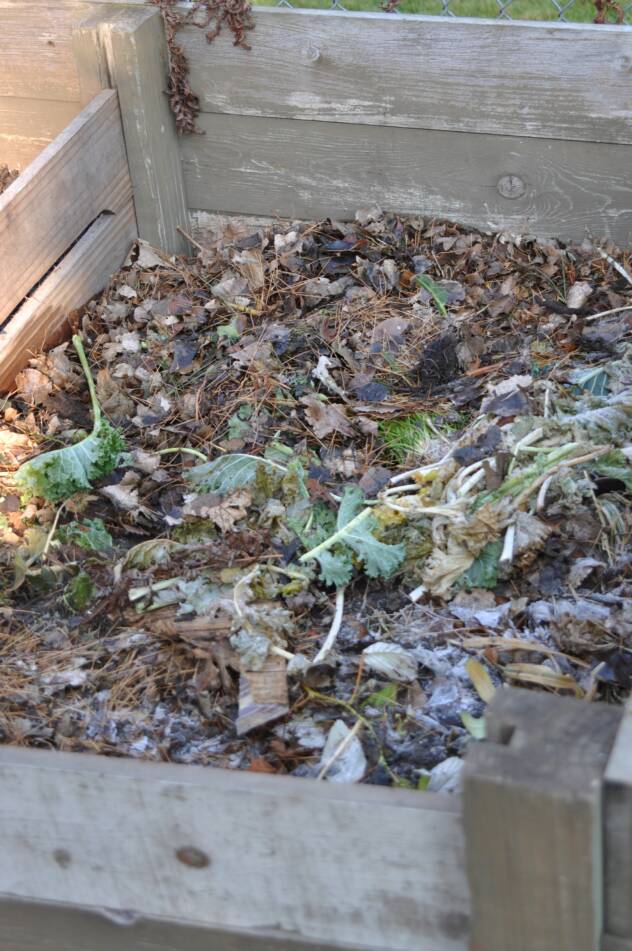
 Above, the compost process begins in earnest when kitchen scraps are mixed with yard waste in Bin # 1


A mix of green(kitchen waste) and brown (yard waste) materials is ideal. I use everything from the garden EXCEPT weeds with seeds. I have learned the hard way that weed seeds will make it through most backyard composting systems. These piles are not usually large enough to generate the high heat needed to kill weed seeds. I am also very careful about which spent flowers with seeds I put into my compost piles as well. Your garden will be entirely black-eyed susans, for example, or purple coneflowers if you put the flower heads with these seeds into your compost. I generally cut off the flower heads and then throw the stems and leaves into the compost. Otherwise I just pull up over-zealous plants when they’ve finished blooming and pile them in a dark corner under the evergreens in the back of the yard where they are out of sight. There they break down but don’t get enough light for the seeds to germinate.

 Bins number 2 and 3 show us the various stages of waste becoming soil.  Bin number 3 below is full of healthy happy compost just waiting to spread its organic fertile magic!

As for brown material, hay without seeds will work, but is expensive. I have sometimes used oat straw that has seeds in it, the kind used for Halloween decorations, particularly if someone gives it to me free. If I’m sure the pile will be completely composted, then I feel okay about adding it to the compost pile. The sprouts of oat seeds from the straw are easily identifiable and pull up readily if a few of them make it through the composting process. But, I wouldn’t want them all over the garden, so I don’t use oat straw as mulch.

Once a summer I do a major turning of the piles. This is when a strong husband comes in handy. But I have done it myself, it just takes a little longer, since I have to do it a bit at a time, not all at once as hubby prefers (“Let’s just get it over with!”)


Margaret's compost system is the most functional home composting method that I've ever seen.  Notice how the posts are all slotted which makes moving and scooping the pile very easy.

Making compost in Minnesota has the advantage of the freeze / thaw process that helps break down organic matter without any help from you at all. It takes about a full season to make really good compost. Once you have the cycle started you can easily keep it going and will be supplied with compost pretty much throughout the growing season.

I have three compost bins that my husband built for me at least 20 years ago. They are about 4 feet across and 5' deep. They stand side by side with removable boards in the front of each bin, and also between the bins so that turning material from one bin to the next is not too difficult. I always keep fresh material separated from the 1/2 completed compost, and from the aged compost, so three bins are needed.

Once a bin is emptied by using the compost for potting-up spring plants or spreading it on the gardens, I turn the next most finished compost into it. This aerates the pile and gets it cooking. Then I turn the least finished compost into the just emptied bin and start a new pile. Composting fits naturally into the cycle of growing and life in the garden.

Try it you’ll like it!

 From the kitchen to the garden and back to the kitchen, Margaret's compost system is easy to build, fun to use, and it makes the best dirt around, just have a look at Margaret's gardens to see for yourself!


Thursday, October 22, 2009

Growing Power In Minneapolis

In our fair cities of Minneapolis and St. Paul, the gap between the haves and have-nots is so striking that it can literally be tasted. The difference in food selection and availability between low-income neighborhoods and wealthy neighborhoods is painfully obvious. In this world, far to few folks acknowledge that access to healthy foods is a basic human right.
Now's the time for us to stand up together and work for a better future, where healthy food is available and accessible to everyone.
Click below to read how Giving Tree Gardens has worked this growing season with an amazing array of folks from around the country to start growing community power, personal health, and food justice here at home!

CLICK HERE to read The Seed #31, Food Justice!

Tuesday, September 22, 2009

Russ Henry and GIving Tree on the RADIO


WE'RE GONNA BE ON THE RADIO!
KFAI Radio Without Boundaries is going to air a documentary featuring Giving Tree's Gardens at the Seward Co-op and Deli in Minneapolis
This Thursday the 24th of September during the 6pm news!


CLICK HERE TO LISTEN TO THE FULL 7 MINUTE DOCUMENTARY!

 
Design by Free WordPress Themes | Bloggerized by Lasantha - Premium Blogger Themes | Blogger Templates